Lump Charcoal vs. Briquettes: What's the Difference?

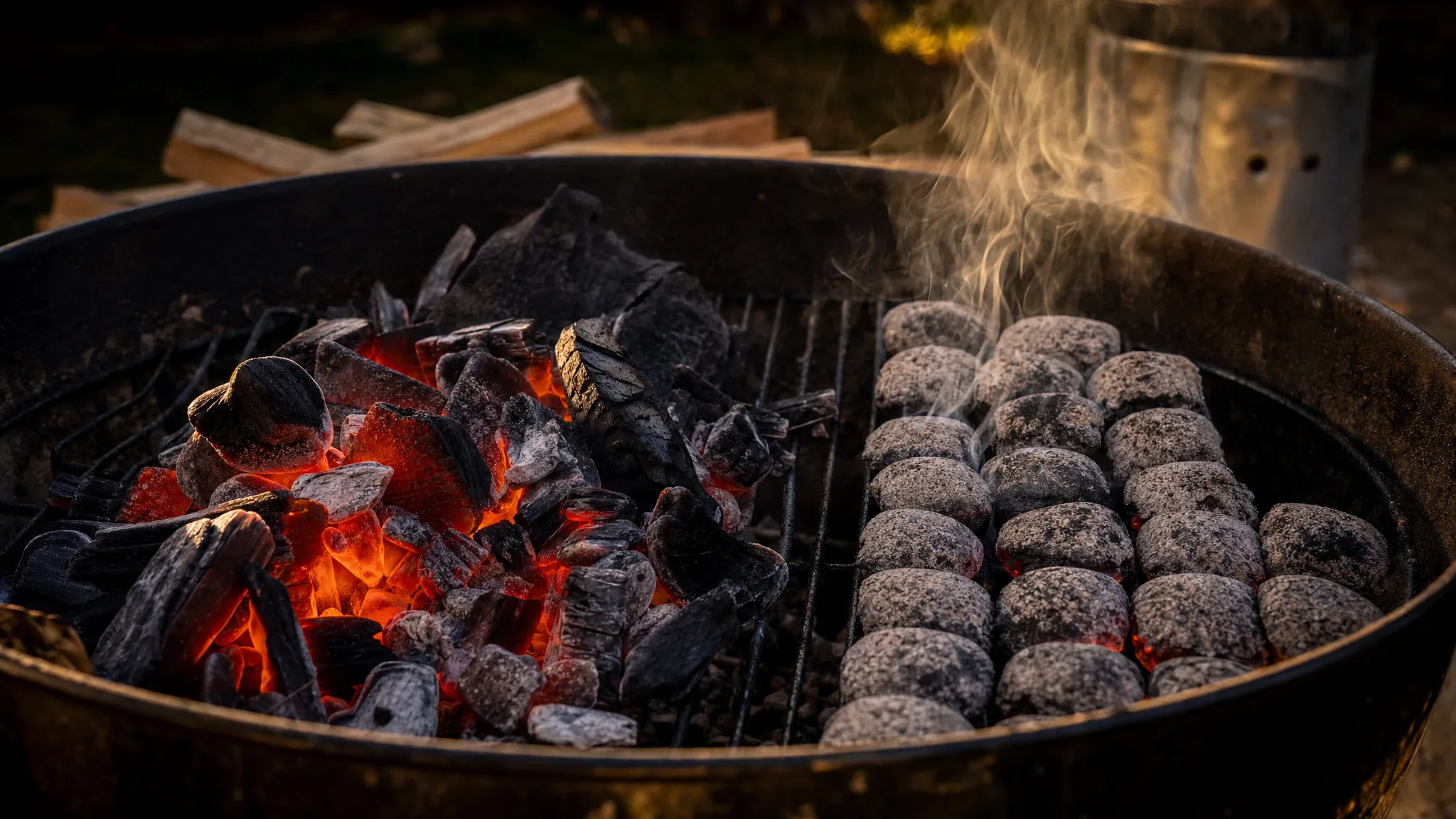
Walk into any backyard where somebody takes their grilling seriously, and eventually the argument starts. One guy swears by lump charcoal because it burns hot and clean and smells like real wood. The other guy swears by briquettes because his fire is still going strong three hours later while the lump guy is dumping another half bag on the grate. Both of them are right, which is exactly why this comparison keeps getting argued over beers.
Here's the thing most of those arguments miss: lump charcoal and briquettes are not competing brands of the same product. They are two different fuels with two different jobs. Lump is a sprint. Briquettes are a marathon. Once you understand what each one is actually built to do, the whole "which is better" question falls apart and gets replaced by a much more useful one — which one is better for this cook, on this grill, tonight.
So let's settle it properly. We're going to walk through burn time, peak temperature, flavor, ash production, consistency, and cost — the six things that actually decide how your food turns out — and then give you a straight answer for the cooks you run most often.
What Actually Comes in the Bag.
Before you can compare performance, you have to know what you're burning. The two fuels start from the same raw material — wood — but they take completely different paths to your grate.
Lump charcoal is wood, and basically nothing else.
Lump charcoal is made by heating hardwood in a kiln with very little oxygen. That process, called carbonization or pyrolysis, drives off water, sap, methane, and volatile compounds, leaving behind chunks of nearly pure carbon that still hold the irregular shape of the log they came from. No binders, no fillers, no additives.
That's the entire appeal. You're burning carbonized wood, so what comes off the fire is wood smoke. The downside is baked into the same fact: because it's just chunks of wood, every piece is a different size, shape, and density. A single bag can contain fist-sized slabs, golf-ball chunks, and a pile of pea gravel at the bottom.
Briquettes are engineered, and that's the point.
Briquettes take charcoal dust and sawdust, mix it with a binder — usually cornstarch or another starch — and compress it into uniform pillow shapes. Some brands add limestone as a filler, and some add sodium nitrate to help them light. The result is a fuel where every single piece is the same size, the same weight, and the same density.
That uniformity is the whole product. It's why a bed of briquettes holds a steady temperature for hours with almost no babysitting, and it's why competition cooks and kettle-grill veterans still buy them by the pallet.
| What's in the bag | Lump charcoal | Briquettes |
|---|---|---|
| Base material | Carbonized hardwood logs | Charcoal dust and sawdust, compressed |
| Additives | None | Starch binder, often limestone filler, sometimes sodium nitrate |
| Piece consistency | Wildly variable, even within one bag | Uniform size and weight |
| Unusable pieces | Roughly 20-50% of a bag can be too small or contain debris | Very little waste or dust |
| Smell when lighting | Wood smoke | Wood smoke, sometimes a faint chemical note until fully ashed over |
Burn Time: The Biggest Practical Difference.
If you only remember one thing from this article, make it this one. A full chimney of lump charcoal gives you roughly 45 to 90 minutes of genuinely hot fire, and maybe two hours before it's fading. A full chimney of briquettes will hold useful heat for three to five hours, and pound for pound they burn somewhere in the neighborhood of 30 to 40 percent longer than lump.
That single fact reshapes how you plan a cook. Grilling burgers for six people? A chimney of lump is perfect — it's hot, it's fast, and you're done before the fire ever matters. Smoking a pork butt for nine hours? Doing that on lump means you're refueling every hour and a half, and every time you open the lid to add charcoal you're dumping heat and extending the cook.
This is also why briquettes dominate the snake method and the Minion method, the two layouts backyard cooks use to get a long, slow burn out of a kettle. Both techniques depend on a predictable chain of fuel igniting at a predictable rate. Uniform briquettes give you that. Irregular lump gives you a fire that surges, sags, and surprises you — which is fun at a party and miserable at hour seven of a brisket.
On a pellet grill or a dedicated offset smoker, this whole debate matters less, but if you're running a kettle, a drum, or a kamado, burn time is the number that should drive your purchase. If you want to see how fuel choice plays into a long cook end to end, our walkthrough on how to smoke a pork butt shows exactly where steady heat pays off.
Temperature: Which One Burns Hotter?
This is where the conventional wisdom gets interesting, because the answer depends on whether you're measuring per gram or per chimney.
In a lab, lump charcoal wins. When USDA Forest Products Laboratory researchers tested both fuels in a bomb calorimeter, lump charcoal showed a higher heat of combustion — essentially more potential energy packed into each gram of fuel. That matches what every lump loyalist insists they can feel.
But in a real grill, using a real chimney starter, the result flips. America's Test Kitchen ran thermocouple tests on full chimneys of both fuels and found briquettes producing average temperature highs of roughly 666 to 729°F, compared with about 546 to 664°F for the same volume of lump charcoal. Why? Because a chimney holds about six quarts either way, and a chimney full of briquettes weighs five to six pounds while a chimney full of lump weighs only two to four. You're simply burning more fuel mass.
Where lump claws it back is peak intensity. Pile a big bed of lump in a kettle, open the vents, and give it air, and it will spike hard — well past 800°F and approaching 1,000°F in the hottest spot. That's the fire you want for a steak crust or a screaming-hot sear on a cast iron grate. Briquettes will get hot, but they cap out lower and settle into a steady rhythm faster.
| Performance metric | Lump charcoal | Briquettes |
|---|---|---|
| Time to cooking temp (chimney) | About 10-15 minutes | About 20-30 minutes |
| Average high, full chimney | Roughly 545-665°F | Roughly 665-730°F |
| Peak spike with airflow | Up to about 1,000°F | Around 800°F |
| Useful burn time | 1-2 hours | 3-5 hours |
| Reaction to vent changes | Fast and dramatic | Slow and gentle |
| Ash by weight | About 1-2% | About 8-10% |
Flavor: What Each Fuel Does to Your Food.
Here's a reality check that saves a lot of people a lot of money. The charcoal itself is not your flavor. The fuel creates heat and a baseline of smoke; the flavor comes from what you put on top of it — wood chunks, rub, rendered fat hitting hot coals, and the Maillard reaction on the crust.
That said, the two fuels are not flavor-neutral relative to each other. Lump charcoal made from oak, hickory, ash, or beech throws a light, clean wood note into the cook, and that note varies by the hardwood the manufacturer used. It's subtle but real, and it's the closest thing to cooking over a live wood fire you can get in a kettle.
Briquettes are much more neutral. Good quality briquettes burn clean and let your rub and smoke wood do the talking. The catch is the lighting phase: binders, fillers, and ignition additives can produce a faint chemical smell in the first few minutes. That's normal, and it's exactly why you never cook over briquettes until they're fully covered in gray ash. If you've ever had a burger taste like lighter fluid, the fuel wasn't the problem — impatience was. For a deeper dive into where real smoke flavor actually comes from, our guide to the best woods for smoking meat is worth your time.
One thing to avoid outright: instant-light briquettes soaked in lighter fluid. They're convenient, they're everywhere, and they will put a petroleum edge on your food that no amount of sauce covers up. Use a chimney starter instead and you'll never look back.
Ash: The Quiet Dealbreaker.
Ash doesn't get discussed much, but on a long cook it decides whether your fire survives. Lump charcoal leaves behind roughly 1 to 2 percent ash by weight. Briquettes leave 8 to 10 percent, because the limestone filler and binders don't burn — they become powder.
On a two-hour burger-and-dogs cook, that difference is a cleanup chore. On a ten-hour smoke, it's a performance problem. A thick bed of ash chokes the airflow coming up through your charcoal grate, and when airflow drops, your temperature drops with it. That's the point where a cook starts chasing vents, adding fuel, and wondering why the smoker won't hold 250°F.
Two habits fix this. First, empty the ash pan or the bottom of the kettle before every cook — don't start with yesterday's ash bed. Second, on long briquette cooks, plan to stir or knock the ash down through the grate at the halfway mark when you're already adding fuel. Lump sidesteps most of this, which is one of the reasons offset and kamado cooks like it.
If you're weighing the environmental side of this decision too, our piece on whether charcoal is bad for the environment covers sourcing, kiln methods, and why responsible lump producers matter.
Consistency: Where Briquettes Win and Lump Fights Back.
Consistency is the least glamorous category and the one that separates a relaxing cook from a stressful one.
Briquettes are predictable by design. Same size, same weight, same spacing, same burn. Build a two-zone fire with briquettes and you can almost set a clock by it. Stack them in a ring and you can predict within twenty minutes when the fire will reach the far side.
Lump is the opposite. In testing, ATK found that 20 to 50 percent of the lump charcoal in the bags they surveyed was too small to use — pieces that fall straight through a chimney or a grate — and some bags contained foreign objects like rocks. That's a real cost you're paying for, and it's why serious lump users shake the bag before pouring and sort the big chunks from the small.
The trade-off is responsiveness. Because lump is irregular and porous, it reacts to vent changes almost immediately. Crack the intake and the fire wakes up in a minute or two. Briquettes take their time. If you like cooking by feel and adjusting on the fly, lump is more satisfying. If you like setting a fire and walking away, briquettes are kinder.
Cost: The Math Nobody Actually Does.
Briquettes almost always look cheaper on the shelf. Per pound, they usually are — often dramatically so during holiday sales, when a twin pack of briquettes can cost less than a single bag of decent lump.
But price per pound is the wrong number. The right number is cost per usable cook.
Lump runs lighter, so a bag goes further by weight in a short, hot cook. But a big chunk of each bag is unusable gravel, and you'll burn through lump fast on anything longer than an hour. Briquettes cost less per pound, pack more usable mass per chimney, and burn 30 to 40 percent longer — which means for slow cooks they're usually the cheaper fuel by a wide margin.
Where the math flips back is quality. Cheap lump is genuinely bad: uncarbonized chunks that smoke and smolder, rocks, and dust. Good lump — dense hardwood, consistent chunk size, dry — costs more but burns like a completely different product. Buying mid-priced lump from a brand you trust beats buying the cheapest bag on the pallet every time.
The Hybrid Method Pitmasters Actually Use.
You don't have to pick a side. Most experienced backyard cooks keep both bags in the shed, and they use them together.
The classic play is a briquette base with a lump top-up. Build your long, steady coal bed out of briquettes for the slow portion of the cook, then throw a handful of lump on top when it's time to finish hot and fast — chicken skin, reverse-seared steak, sausages. You get the stability of briquettes for the hours that matter and the searing intensity of lump for the two minutes that matter.
A second version: fill the chimney with briquettes for a reliable light, then pour them into a bed of lump so the irregular chunks pack around the uniform ones. The briquettes anchor the heat while the lump gives you spikes when you open the vents.
And a third, useful for anyone running a kettle for long cooks: briquettes for the snake, lump for the chimney you dump on top to start it. Predictable burn, fast start.
Neither fuel is precious. The whole game is heat management, and heat management is easier when you have the right tool for each phase of the cook. That's the same principle behind direct versus indirect grilling — match the setup to the job, not the other way around.
A Simple Decision Guide, by the Cook and Not the Bag.
Here's the practical version. Find tonight's cook in the left column and buy accordingly.
| Your cook | Use this | Why |
|---|---|---|
| Steaks, searing, high-heat finish | Lump | Highest peak heat and fast response to vents |
| Burgers, dogs, weeknight grilling | Lump or briquettes | Either works; lump lights faster, briquettes are cheaper |
| Brisket, pork butt, ribs, long smokes | Briquettes | Steady 3-5 hour burn and predictable fuel consumption |
| Snake or Minion method in a kettle | Briquettes | Uniform pieces ignite in a predictable chain |
| Kamado or ceramic cooker | Lump | Efficient burn, clean flavor, minimal ash in a sealed cooker |
| Offset stick burner | Lump as a coal base | Clean heat under the wood splits, less ash to choke the fire |
| Feeding a crowd, on a budget | Briquettes | Lowest cost per usable hour of heat |
Practical Tips That Apply to Both Bags.
Whatever you buy, a few habits make more difference than the fuel itself.
Always light with a chimney starter.
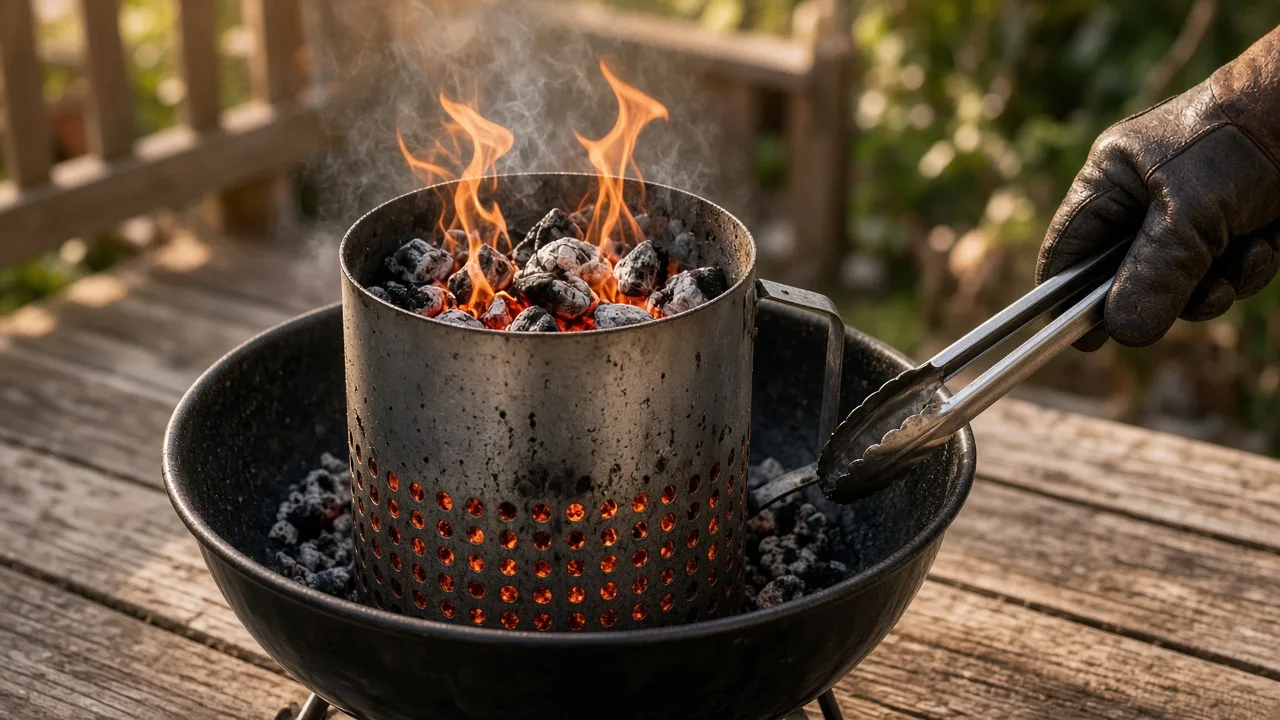
No lighter fluid, no instant-light briquettes, no gimmicks. A chimney gets a full load of charcoal going in 15 to 25 minutes with two sheets of newspaper or a fire starter cube underneath, and it starts the fire evenly instead of in one spot. It's the single best twenty dollars you'll spend on grilling gear.
Wait for the ash.
Charcoal is ready when the pieces on top are gray and ashing over, not when they're black and smoking. This matters more with briquettes, where you're literally burning off manufacturing binders, but it applies to both. Cooking early gives you acrid smoke and uneven heat.
Arrange the fire, don't just dump it.
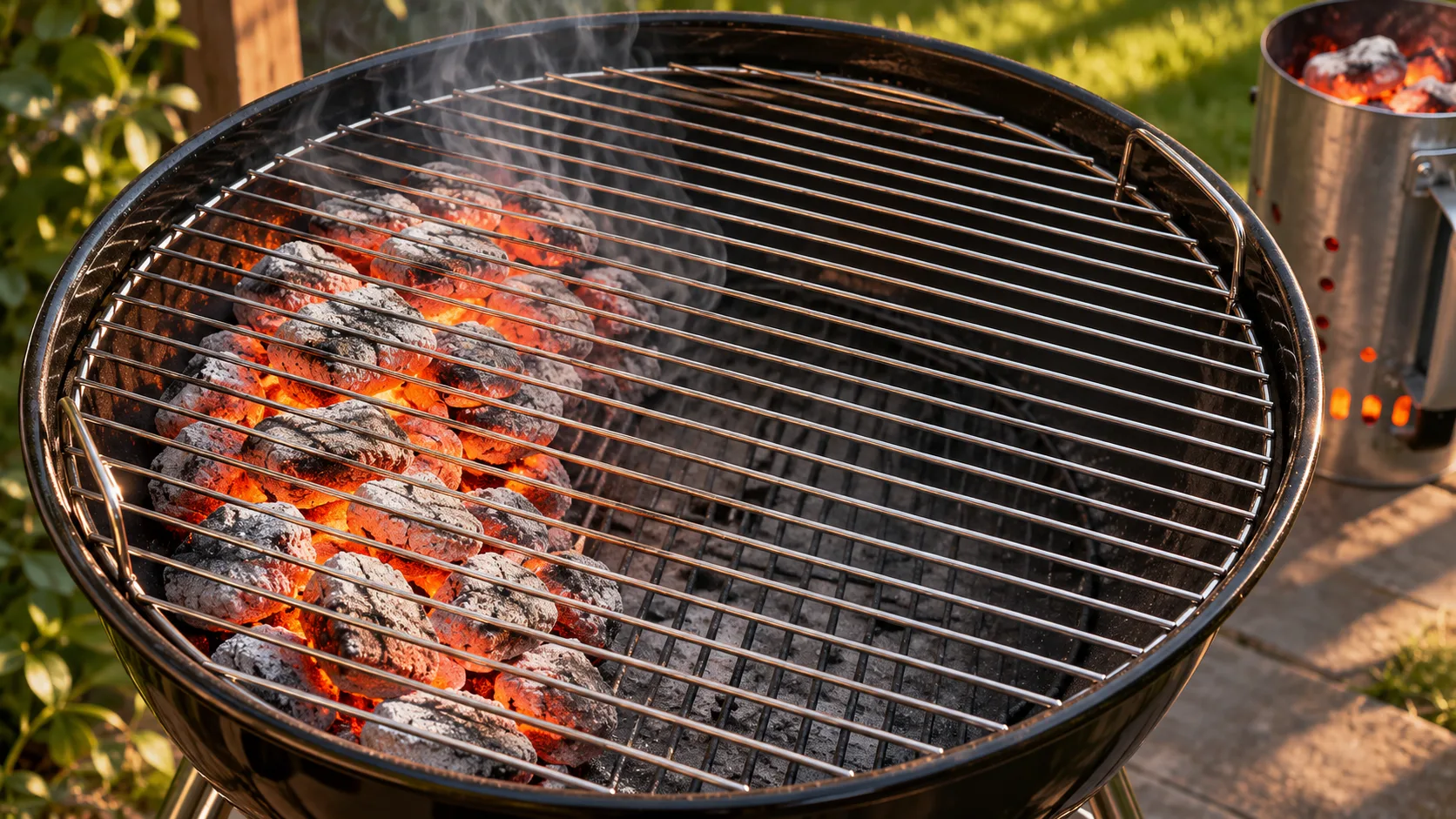
Pour your lit coals into a two-zone setup — coals banked on one side, empty space on the other — and you've instantly got a sear zone and a safe zone. That one layout solves ninety percent of grilling problems, from flare-ups to uneven cooking. For briquettes, a single neat layer gives you a gentle, even heat; stacked doubles give you a hotter, more aggressive fire.
Store it dry and sealed.
Charcoal absorbs moisture. A bag left open in a humid garage lights slowly, smokes heavily, and burns poorly. Keep it in the original bag, rolled shut, on a pallet or shelf off the concrete.
Never dump hot ash.
Ash holds heat for a surprisingly long time. Let it cool completely — a day, ideally — before it goes anywhere near a trash bag, and never put it in a plastic bin. If you're dumping it in the yard, make sure it's cold to the touch first.
The Bottom Line.
Lump charcoal burns hotter, lights faster, leaves a fraction of the ash, and delivers the cleanest wood flavor you can get without an actual log fire. It's the right fuel for searing, for quick weeknight cooks, and for anyone who wants their grill to feel like a live fire.
Briquettes burn longer, hold temperature with almost no attention, cost less per usable hour, and turn a long smoke from a babysitting job into a background task. They're the right fuel for brisket, pork butt, ribs, and any cook measured in hours instead of minutes.
The only wrong answer is picking a side and refusing to move. Keep a bag of each, match the fuel to the cook, and stop letting a bag of charcoal decide how your dinner turns out. That's how you take control of the fire — and a cook who controls the fire controls the food.